

Sensurround Q. Catgirl is sitting on the floor with an almost-empty bottle of Żubrówka, tail lazily swishing back and forth. She points dramatically at a whiteboard that she definitely did not set up herself.
“Okay. Okaaay. Lishten. This ish one of my favorite shcience shtories because... because everybody was wrong. Which is comforting.”
She shakes herself off and takes another sip.
“So. Imagine you’ve got a piece of hawt metal. Like... a frying pan. Or Schrödinger’s box after I’m done with it. It glows! First red, then orange, then yellow, then kinda white. So these smarty-pants physicists wanted to calculate exactly how much light a hot object makes at every color.”
She burps gently, and blushes a bit.
“They used normal physics. Newton. Maxwell. Everybody was all...”
She puffs herself up importantly.
“Ah yes, the equations are magnificent! And then the equations did a faceplant.”
She draws a graph.
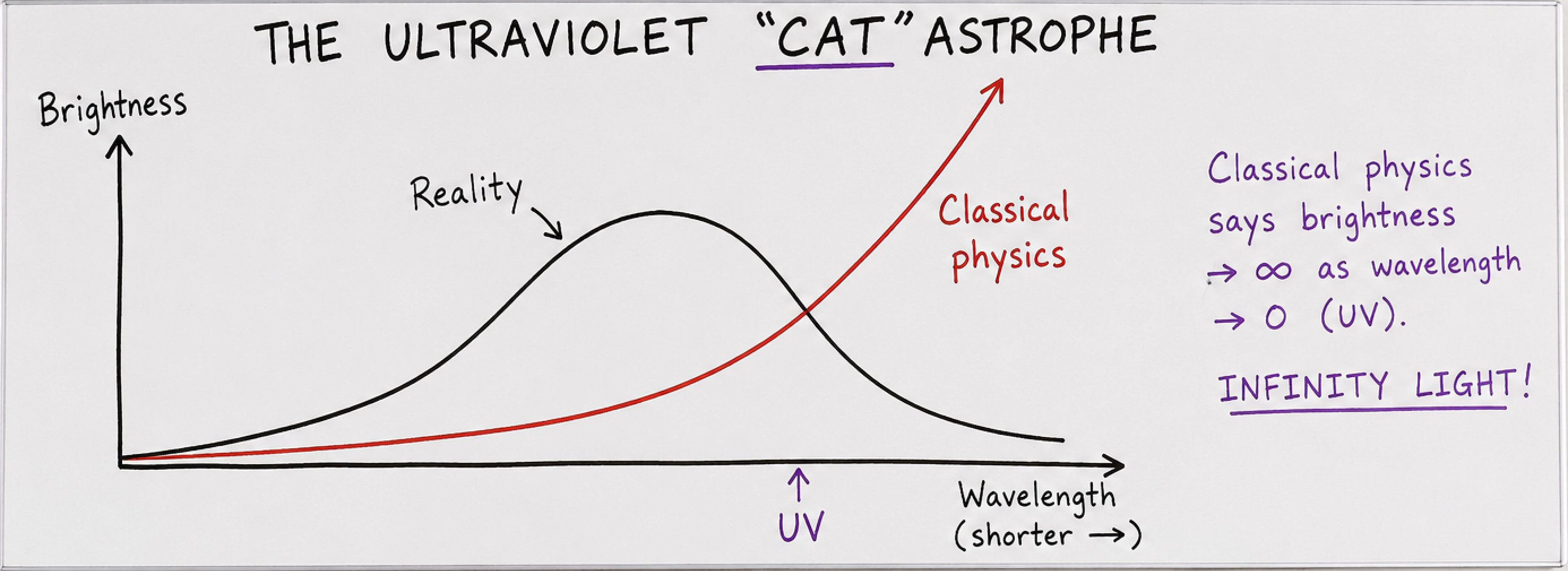
“See this?” she says, poking the right side with the marker. The old equations said that as the light gets bluer and bluer, shorter wavelength, higher energy, the brightness should just keep going up...and up...and up...FOREVER.”
She throws both hands into the air.
“INFINITY LIGHT! Every hot object should be spraying out an infinite amount of ultraviolet radiation.”
She blinks.
“Which... would be awkward. You couldn’t cook breakfast because the stove would instantly vaporize the kitchen and probably France.”
She nods solemnly.
“Scientists called this the ultraviolet catastrophe, which sounds like a wonderful band name for a 90’s grunge act. So everybody was scratching their heads.”
She scratches behind one ear.
“Max Planck comes along in 1900. He doesn’t actually want to invent a whole new physics. He basically says...”
She shrugs dramatically.
“Okay... what if energy comes in tiny little packets instead of being perfectly smooth?”
She holds up her hand like she’s handing out treats.
“Not this much.”
Tiny pinch gesture.
“Not that much.”
Another tiny pinch.
“But exactly one packet. Or two packets. Or three packets. No half-packet. No one-point-seven-three packets.”
She jumps, excitedly
“Packet packet packet packet packet packet!”
She grins excitedly
“So instead of a hot object being able to jiggle by any amount...”
She wiggles.
“...it can only jiggle in little steps.”
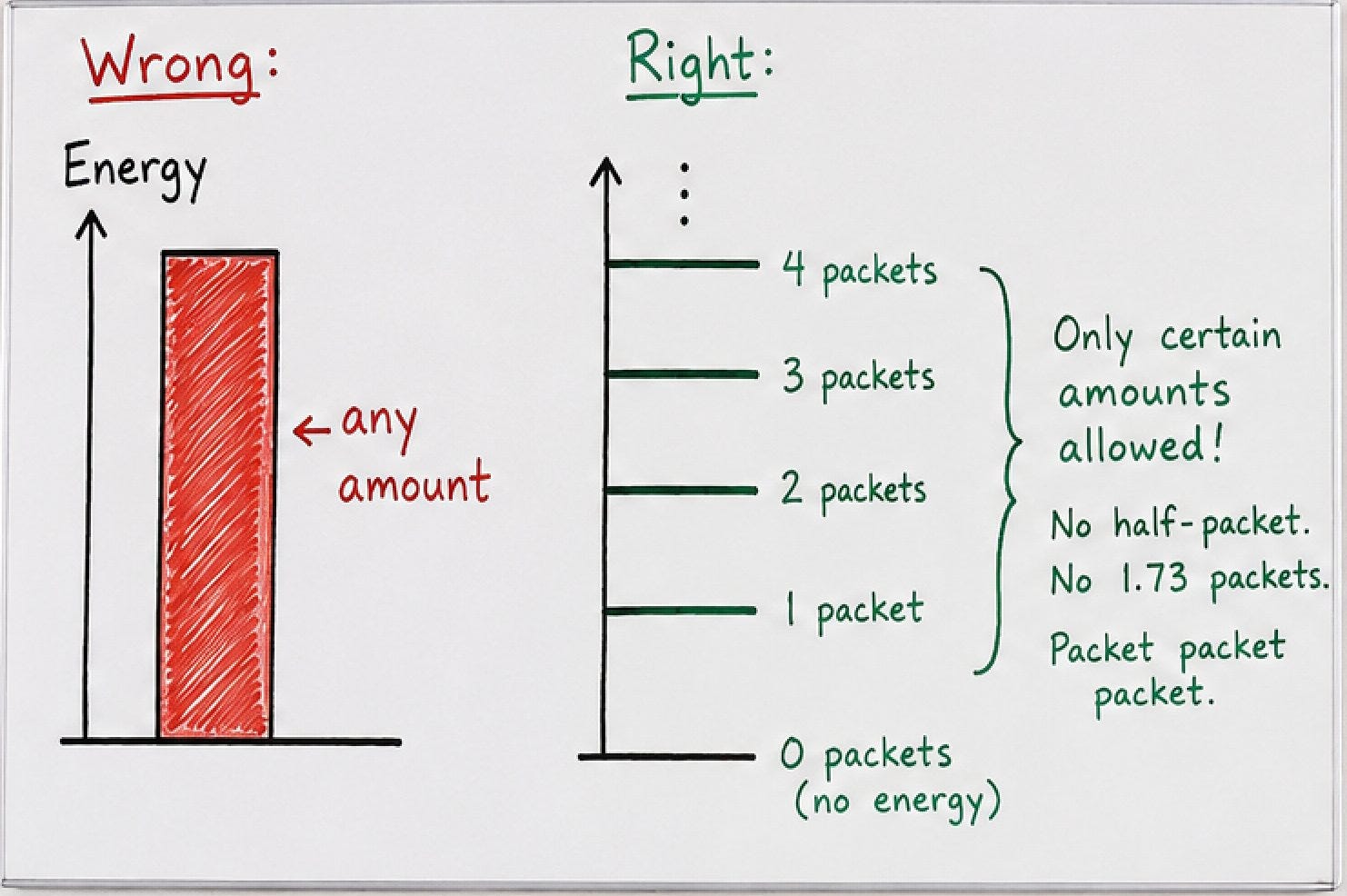
“This tiny change completely fixes the graph! No more infinity. No more universe exploding from ultraviolet pancakes. But here’s the funny part. Planck thought this was just...”
She waves her bottle vaguely.
“...math duct tape. He was like, ‘Please don’t think too hard about why this works.’ Then Einstein shows up in 1905.”
She points dramatically at an imaginary doorway.
“He goes... ‘Actually... maybe light itself comes in little packets.’”
“Boom. Those packets eventually got called photons. So light wasn’t just a smooth wave anymore. It was wave-y, but also came in little chunks.”
She squints.
“I know. I’ve been drinking and that still sounds weird. And then?...”
She starts counting on her fingers.
“Electrons only having certain energies. Atoms having discrete energy levels. The photoelectric effect. Wave functions. Heisenberg. No, not the drug guy from the TV show, thats where he got the name from. Schrödinger... who I’m still mad at.”
She scowls, then continues
“The whole beautiful quantum mess grows out of that one tiny idea.”
She writes on the board:
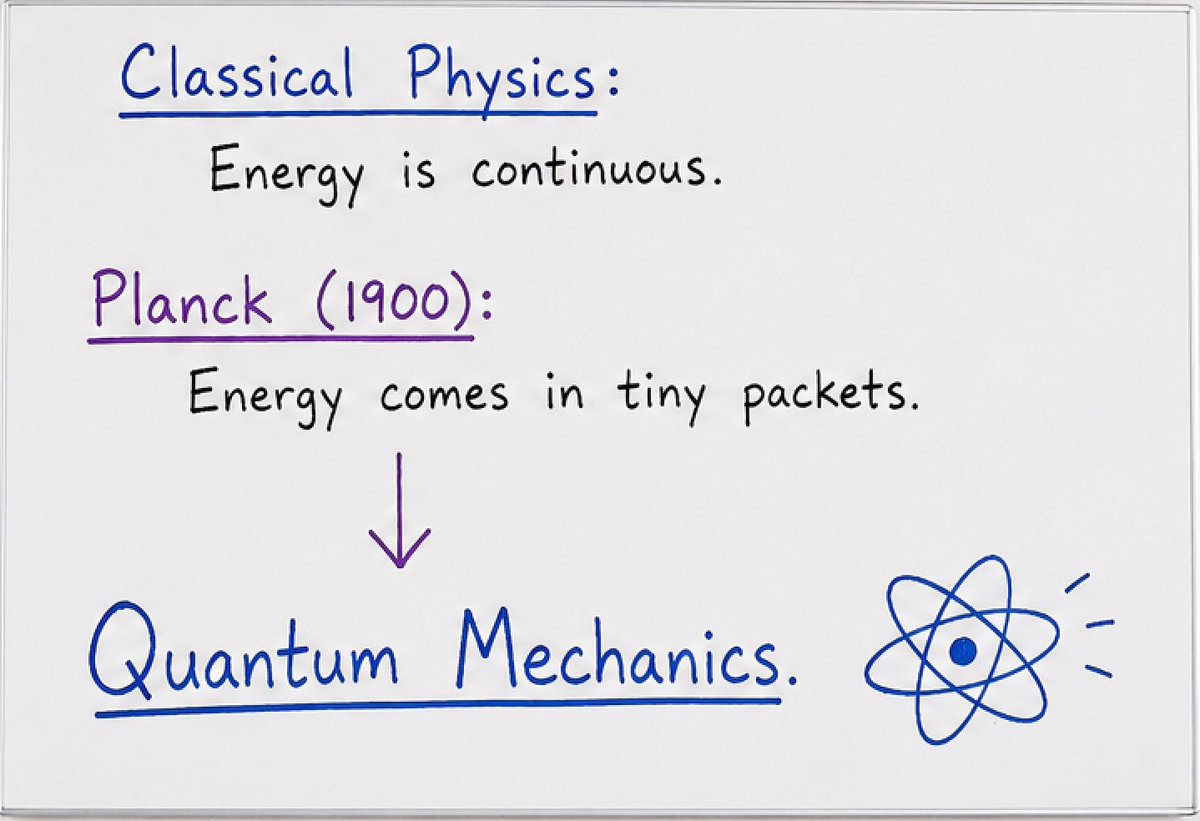
“So that’s why people say Planck started quantum mechanics. Not because he solved every problem, but because he was the first guy willing to say...”
She raises the bottle in a toast.

“Maybe Nature doesn’t let you order infinite refills. Maybe energy comes in shots.”
She drains the last sip.
“...which, incidentally...”
She peers into the empty bottle.
“...appears to be how vodka also works.”
These sources collectively reveal that high-performance computing is no longer just an engineering discipline but a strategic backbone of global power, evolving from defense-funded supercomputers into a convergence of AI acceleration, exascale systems, and emerging quantum architectures. The forward solution lies in integrating these layers into a unified compute ecosystem. where classical HPC handles scale, AI drives adaptive optimization, and quantum systems target high-complexity problems such as cryptography, materials science, and climate modeling. To move fastest and lead effectively, institutions must invest in hybrid compute infrastructure, secure supply chains for advanced semiconductors, and algorithmic innovation that bridges classical and quantum domains. The competitive edge will belong to those who treat computing not as hardware, but as a continuously learning, self-optimizing system, capable of accelerating discovery, reducing uncertainty, and reshaping economic and geopolitical advantage in real time.
The band Ultraviolet Catastrophe, like the theoretical physics thing it was named for, already does not exist.